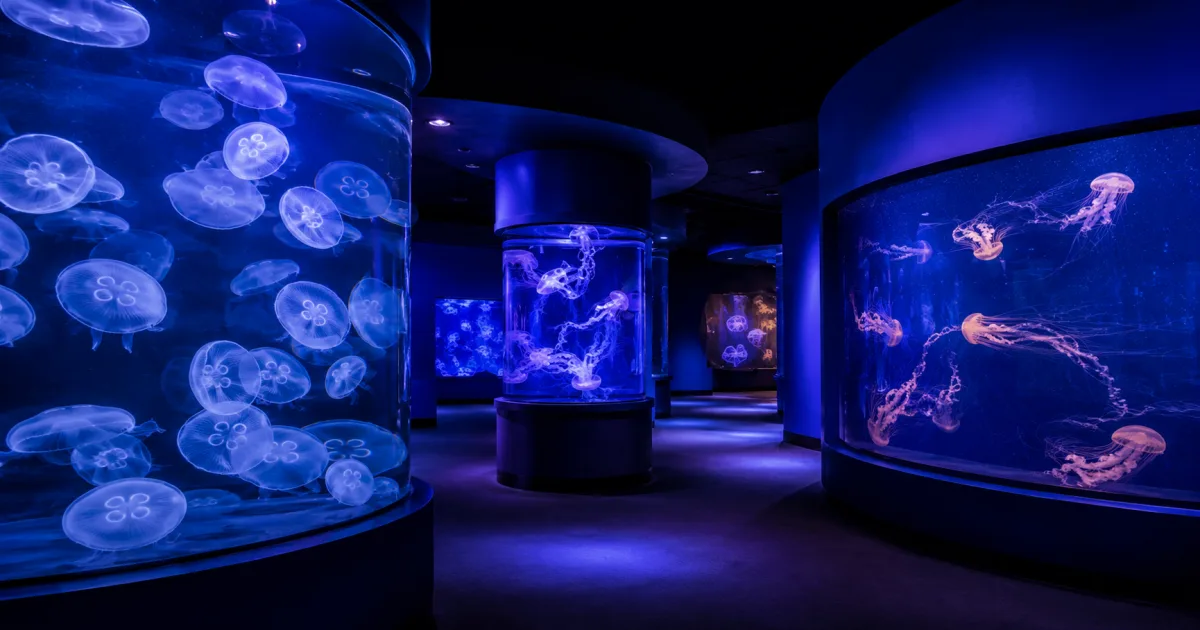
The Jellyfish Museum in Pompano Beach is a useful option for travelers looking for an unusual indoor activity in South Florida. The museum opened in spring 2026 and received renewed national attention in August for its specialized collection. It is located at 199 N Ocean Boulevard near the Pompano Beach pier. Its official website currently lists daily hours from 10 a.m. to 7 p.m., with entry closing 30 minutes before the museum closes. Because hours, admission prices, and capacity can change, reserve and confirm the details on the official site on the day you visit.
What the museum contains
This is not a general aquarium. The experience focuses on live jellyfish displayed in tanks designed for cold-water and tropical species. The museum says it can show up to 25 species from different oceans. The number visible on a particular day may vary as animals and exhibitions rotate, so treat “up to 25” as a maximum rather than a promise of an identical list for every visit.
The tanks are accompanied by immersive projections and educational material. Lighting is intentionally low so visitors can see the movement and translucence of the animals. The City of Pompano Beach described the project as a nearly 10,000-square-foot facility with more than 6,000 square feet of exhibition space. The city also said the jellyfish come from licensed aquaculture partners and that the tanks are tailored to the biological needs of each species.
Associated Press coverage published in August reported that the museum holds roughly 20 species at a given time and can rotate them through 21 tanks. That does not necessarily conflict with the museum’s stated maximum of 25: a living collection changes. Species photographed or reported by AP included moon jellyfish, Japanese sea nettles, spotted jellies, and upside-down jellyfish.
Hours, address, and reservations
The museum’s own website is the best current operational reference:
- Address: 199 N Ocean Blvd, Pompano Beach, FL 33062.
- Posted hours: daily from 10 a.m. to 7 p.m.
- Last entry: 30 minutes before closing.
- Reservations: available online through the official website.
We are not fixing a ticket price in this guide because the official site displays different admission choices and discounts, and the amount may depend on the date or visitor type. Check the final amount before paying. The site says discounts may be available for Florida residents, seniors, veterans, active military members, first responders, and educators, and valid identification may be required.
The museum states that it is ADA accessible and welcomes visitors who bring their own mobility devices, but it does not provide wheelchairs. Contact the museum before booking if anyone in your group needs a specific accommodation or assistance.
How much time to allow
The museum does not publish one required visit length for everyone. Your pace will depend on whether you read the displays, spend time watching each tank, or join a guided experience. Leave a flexible block and do not plan to arrive during the final half hour, when admission has already closed.
The setting is intended to be calm, so it works better when it is not treated as a race between tanks. If you are visiting with children, explain that the animals are for viewing and that some rooms have low light. A visitor who is sensitive to projections, ambient sound, or dark spaces should ask staff which areas can be skipped.
Getting there from Miami or Fort Lauderdale
The museum describes itself as about 15 minutes from Fort Lauderdale and about 40 minutes from Miami. Those are estimates, and South Florida traffic can make the trip longer. Check the route at your actual departure time. The address is close to the Pompano Beach oceanfront, restaurants, and pier.
If you are driving a rental car from MIA, prepare with our Miami Rental Car Center guide. Choose the toll method in your rental agreement before leaving the airport and save the exact parking destination. The museum says convenient parking is available nearby, but that is not a guarantee of an open space or a specific price.
Travelers combining the museum with Miami Beach should treat parking rules in the two cities separately. Our Miami Beach parking guide explains the current municipal promotion there; it does not automatically apply in Pompano Beach.
A simple half-day plan
A sensible plan is to arrive with a reservation, visit the museum, and then walk around the pier area. Keep lunch or dinner as a separate stop rather than assuming outside food or drinks can enter the exhibits. The museum can serve as an indoor alternative when beach weather changes, but tickets still depend on availability.
One workable sequence is:
- Verify hours and capacity on the official website.
- Check travel time using current traffic.
- Arrive early enough to park and complete check-in.
- Move through the tanks and projections without forcing a rigid duration.
- Continue to the pier or a nearby meal only after confirming the next venue’s hours.
This order prevents you from placing two paid reservations too close together. It also leaves room if your group wants to spend longer at one display.
Photography and basic rules
The official site warns that flash photography may be restricted near certain exhibits. Set up your phone or camera for low light and follow staff instructions. Do not use flash simply because the room is dark; it may conflict with museum policy and affect other visitors’ experience.
The museum also says entrance staff may inspect bags for security reasons and that video monitoring operates throughout the facility. Keep personal belongings with you. School groups and visitors interested in a guided tour should review the dedicated options before buying regular admission.
Before-you-go checklist
- Reservation confirmed for the correct date.
- Hours rechecked on the day of the visit.
- Address saved: 199 N Ocean Blvd.
- Identification ready if you qualify for a listed discount.
- Accessibility needs discussed in advance.
- Route and parking reviewed without assuming availability.
- Camera prepared for low light without flash.
- Extra time allowed for South Florida traffic.
- Backup activity selected if tickets are sold out.
Bottom line
The Jellyfish Museum works best as a calm, intentional visit rather than an improvised stop just before closing. Its narrow focus distinguishes it from a conventional aquarium: live jellyfish, specialized tanks, projections, and marine-biology interpretation in an indoor space near the coast. Verify hours, price, and availability at the official source, arrive with time to spare, and combine the museum with Pompano Beach without overloading the schedule.