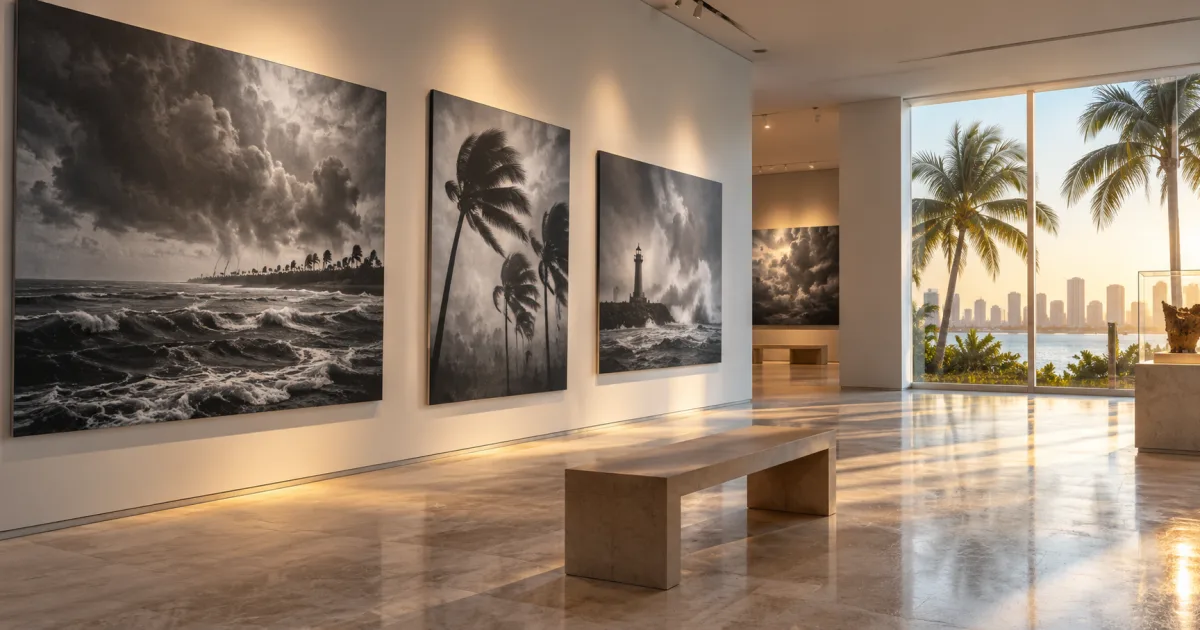
If you are looking for a new cultural stop in downtown Miami, Caught in the Eye: Remembering the 1926 Hurricane can now be added to your itinerary. The exhibition opened at the Museum of Miami on September 18, 2026, exactly a century after the hurricane that changed the young city’s course, and it is scheduled to remain on view through April 11, 2027. This is not an effects-driven attraction or a weather guide. It is a historical interpretation built from archives, personal voices and urban memory.
The practical essentials
- Exhibition: Caught in the Eye: Remembering the 1926 Hurricane.
- Confirmed dates: September 18, 2026 through April 11, 2027.
- Location: Museum of Miami, 101 West Flagler Street, Miami, Florida 33130.
- Focus: Miami’s social, economic and political history before, during and after the 1926 hurricane.
- Announced materials: photo albums, newspapers, film, letters, illustrations and first- and second-hand accounts.
- Confirmed special program: a curator’s tour on November 21, 2026, from 2:00 p.m. to 3:00 p.m.
The museum publishes hours, admission and accessibility details on its planning pages. Because those operating details can change, check them on the day you organize your visit. The closing date appears on the official exhibition page, but it should not be treated as a guarantee of availability at a particular hour.
What the exhibition is trying to explain
The central subject is not simply the storm’s force. The museum treats September 18, 1926 as a dividing line between Miami’s rapid boom and a period of rebuilding. That makes the topic relevant even to visitors who do not usually seek out weather exhibitions: the story connects urban development, economic momentum, politics and the way a community records its past.
The selection comes from the museum’s archive. Albums and photographs reveal places and damage; newspapers show how the disaster was communicated; film adds movement; and letters and testimony restore an individual scale. The museum also announces illustrations exploring the earliest recorded Atlantic and Caribbean hurricanes. Together, those formats place Miami within a longer regional history rather than reducing the gallery to a technical timeline.
The narrative continues beyond 1926. According to the museum, the exhibition follows the storm’s imprint on Miami’s society, economy and politics and links it to later hurricanes, including Donna and Andrew. Visitors can compare how the city, its infrastructure and the language used to remember emergencies changed across generations.
The historical context worth knowing first
A National Weather Service centennial review provides a precise framework. The first storm warning for Florida’s east coast was issued at noon on September 17, 1926. The hurricane warning followed at 11:00 p.m., less than six hours before the estimated Category 4 landfall near Palmetto Bay, about 10 miles south of downtown Miami.
The overnight timing and limited communication systems left many residents with little notice. The eye brought about 35 minutes of temporary calm, which some people mistakenly understood as the end of the storm. The federal agency records 114 lives lost in the Miami area, with others unaccounted for. It also documents winds above 145 mph; an instrument measured 138 mph at 8:12 a.m. before it was blown away.
Those figures are useful for reading the historical objects. They are not a substitute for any current weather information. If adverse weather overlaps with your trip, consult present-day authorities and official channels. The exhibition’s purpose is to understand how a city experienced and remembered a defining event, not to carry 1926 instructions into the present.
A useful way to move through the gallery
You can approach the exhibition in three layers. First, look at the city: identify streets, buildings and landscapes that reveal the scale and speed of Miami’s growth. Second, listen to people: compare the institutional voice of newspapers with the intimacy of letters and recollections. Third, follow the consequences: watch for the economic, political and social decisions that appear after the impact.
This sequence keeps the visit from becoming only a collection of dramatic images. It also works for families with teenagers, students, architecture enthusiasts and residents who know Miami mainly through its present. No advanced knowledge of local history is required because the exhibition is organized around a clear date and story.
The November 21 curator’s tour
The museum has scheduled an approximately one-hour highlights tour with resident historian and co-curator Dr. Paul S. George for November 21, 2026, from 2:00 p.m. to 3:00 p.m. The program is listed as free with museum admission and requires registration. It will take place in the South Building’s second-floor exhibition space.
If that date matches your trip, the tour may be the strongest way to understand why particular objects were selected and how the historical interpretation was assembled. Confirm registration and availability directly with the museum before traveling. “Free with museum admission” does not guarantee a place if capacity has been reached.
Fitting the museum into a Miami day
The West Flagler Street address puts the museum in downtown Miami’s cultural core. To reduce transfers, keep the rest of the day nearby and avoid pairing the visit with a tightly timed Miami Beach plan. If you still need accommodation, use Billetaxo’s hotel search to compare options for your dates and browse the English-language blog for recent Miami and Florida guides.
We have intentionally left out a daily schedule and admission price because operating information can change. Check the museum’s official planning page and any special-program registration before purchasing transportation or a nonrefundable booking.
Before-you-go checklist
- Confirm that the exhibition is still available on your chosen date; the announced closing date is April 11, 2027.
- Review current hours, admission and accessibility details on the museum’s official website.
- If you plan to visit on November 21, complete the curator-tour registration and confirm the meeting point.
- Allow time to read letters, clippings and testimony; the exhibition is not limited to photographs.
- Keep historical context separate from any current weather information.
- Use flexible accommodation and transportation terms when the trip is still months away.
Bottom line
Caught in the Eye gives travelers a timely and specific reason to add a museum to a Miami trip between September 2026 and April 2027. Its value lies in bringing different archival forms together to explain not only what happened, but how the hurricane redirected the city and remained part of its memory. For cultural travelers, curious families and local residents, it offers context that is difficult to obtain from a Miami visit focused only on beaches, shopping or dining.
Sources
- Caught in the Eye: Remembering the 1926 Hurricane — Museum of Miami
- Curator’s Tour—Caught in the Eye: Remembering the 1926 Hurricane — Museum of Miami
- The 1926 Great Miami Hurricane: A century of science advancing warnings from hours to days — National Weather Service
- Things to do in Miami: Voter registrations, tap takeovers and concerts — Axios Miami