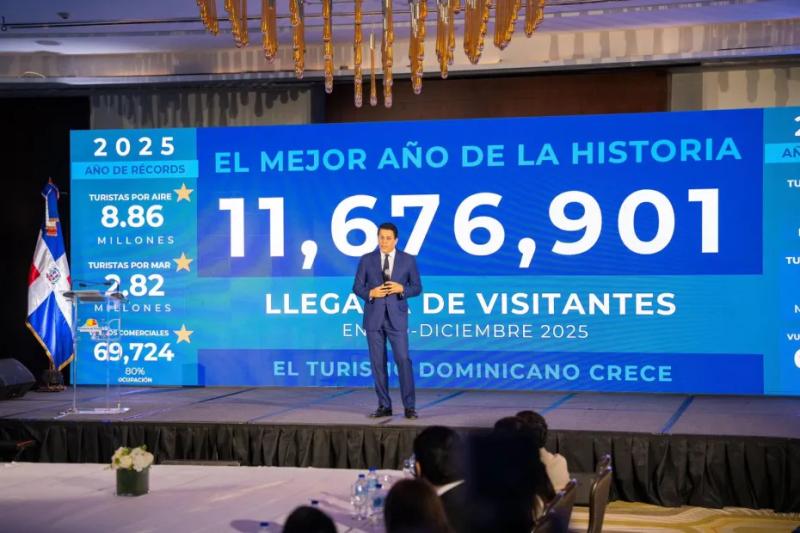
Cuba 🇨🇺 Fading into Oblivion… Dominican Republic 🇩🇴 Breaking Its Own Records
For years, Cuba and the Dominican Republic were two inevitable names when talking about tourism in the Caribbean. Sun, beach, culture, history, and a privileged position in the hemisphere's geography.
But today, the data tells a different story: the Dominican Republic is breaking historical highs, while Cuba fails to recover the lost ground.
The Chart That Summarizes Everything (2000–2025)
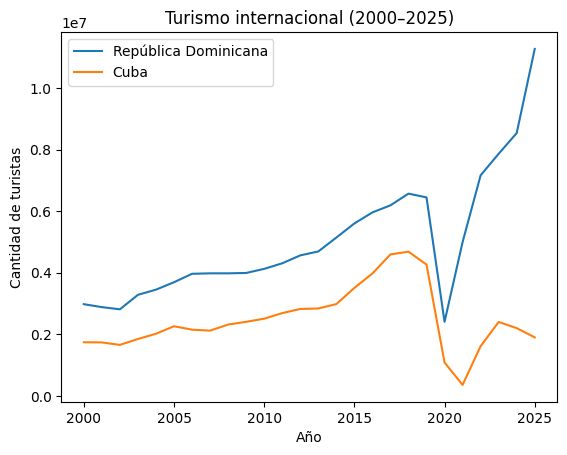
The most important thing is not just the 2020 drop (which was global), but what happens afterward:
2000–2019: sustained growth (with ups and downs) and "normal" regional competition.
2020: pandemic shock and simultaneous collapse.
2021–2025: structural break: one country takes off and the other falls behind.
This pattern is not exclusive to the Caribbean: globally, tourism took several years to normalize after the pandemic. In 2024, the world was practically back to pre-pandemic levels, with around 1.4 billion international tourists (recovery ~99% compared to 2019). Web UNWTO
2020 Was a Hard Blow… But 2021 Marked the True Turning Point
The pandemic affected everyone. The difference was the speed and model of response.
✅ Dominican Republic: Early Reopening + Coordination + Confidence to Invest
The Dominican Republic reopened relatively early (from 2020) and accelerated recovery in 2021, relying on protocols, air connectivity, and a sector push strategy. HVS
The results, in numbers, are compelling:
-
2024 Record: 11,192,047 visitors, combining air tourism and cruises. Presidency of the Dominican Republic
-
2025 Heading to New Record: 10,284,251 visitors in 11 months, projecting a historic close. Presidency of the Dominican Republic
-
The Central Bank reports for January–August 2025 more than 6.08 million non-resident visitors by air. cdn.bancentral.gov.do
This is not "luck". It's a sign of institutional resilience: when there are clear rules, operational facilities, and real space for private investment, the sector adapts faster to external shocks.
❌ Cuba: Slow Recovery, Restrictions, and Macro Crisis That Chokes the Sector
In Cuba, the post-2020 story is different.
Official data published by ONEI shows the collapse and incomplete recovery:
- 2019: 4,263,115 international visitors
- 2020: 1,084,728
- 2021: 356,470
- 2022: 1,614,087
- 2023: 2,436,980 onei.gob.cu
That is: in 2023 Cuba was still well below 2019.
Various analyses indicate that Cuba has not managed to recover pre-pandemic tourism and that recent performance lags behind its Caribbean competitors, in a context where tourism is heavily controlled by state structures. University of Navarra
External factors also weigh in (and it would be dishonest to ignore them): for example, travel restrictions from the U.S. tightened since 2019 affected relevant flows, and part of the demand ended up favoring alternative Caribbean destinations. horizontecubano.law.columbia.edu
Even in 2025, signs of weakness are reported: ONEI (according to press) reported that between January and October the country received 1,477,892 international visitors, below the same period of the previous year, and with closing projections lower than expected. Diario Libre
The Economic Lesson: Open Institutions Tend to Be More Resilient
When tourism is a highly sensitive industry (to public health, air connectivity, security perception, and credit/investment), "how decisions are made" matters almost as much as "what is offered".
More Open Frameworks (🗽): tend to react faster, attract capital, correct supply, create alliances, and sustain operations.
Centralized Models (🗿): tend to move slowly, restrict incentives, and run out of oxygen when the shock requires flexibility.
And the Caribbean does not forgive slowness: if one destination goes down, another goes up. International demand readjusts in real time.
It's Not Just Tourism: It's Confidence, Foreign Exchange, and Future
In the Dominican Republic, tourism has consolidated as a machine for employment, foreign exchange, and investment, reflected in consecutive records. Presidency of the Dominican Republic
In Cuba, tourism stagnation deepens a larger problem: fewer visitors means less income, less investment, less maintenance, and a difficult spiral to break. onei.gob.cu
Closing: Two Islands, Two Models, Two Results
In 2020, the world stopped.
But in 2021, it became clear that not all countries would recover the same way.
Today, the Dominican Republic breaks records. Cuba, on the other hand, struggles to return to a normality that once seemed guaranteed.
And the uncomfortable question is this: how much of this gap is explained by "destiny" and how much by the decisions of the economic model?
Sources Consulted
- Visitor statistics and series 2019–2023 (ONEI, Cuba). onei.gob.cu
- 2024 Tourism Record (Presidency of Dominican Republic). Presidency of the Dominican Republic
- Visitors in 11 months of 2025 (Presidency of Dominican Republic). Presidency of the Dominican Republic
- Tourism flow January–August 2025 (Central Bank of Dominican Republic). cdn.bancentral.gov.do
- Analysis on Cuba's Tourism Lag (University of Navarra). University of Navarra
- Analysis on Post-Covid Dynamics and Regional Competition (Columbia – Cuban Horizon). horizontecubano.law.columbia.edu
- Global Tourism Recovery and International Context (UN Tourism, official PDF). Web UNWTO
- 2025 Report on Cuba Tourism Projections (press with reference to ONEI). Diario Libre